
Always a Peer: Helen Skipper’s Story
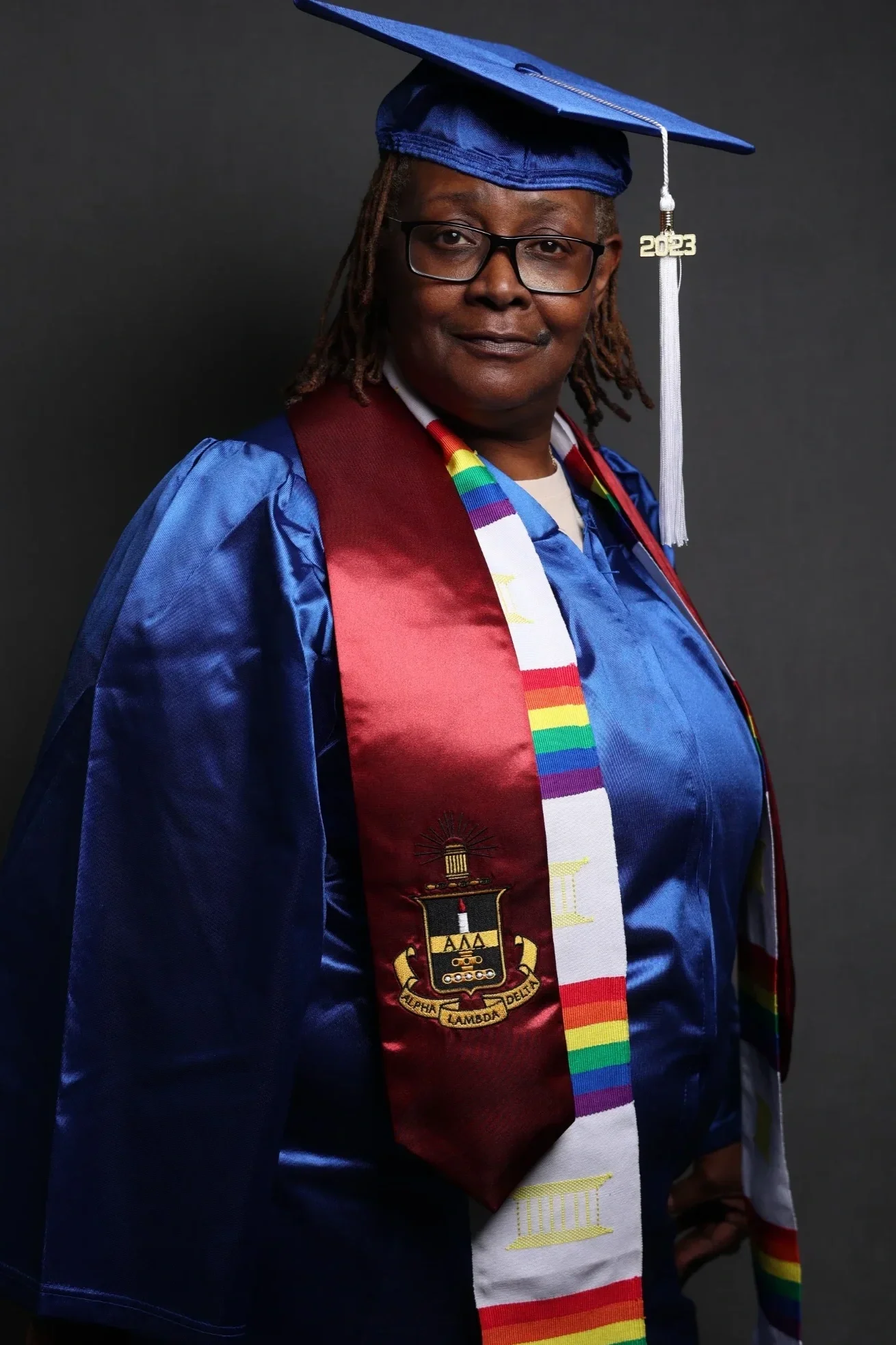
On the day of Helen “Skip” Skipper’s final arrest, she had an out-of-body experience. She had been caught trying to smuggle some items out of a store that she’d already shoplifted from earlier in the day. She was 43 years old.
The manager told her he wouldn’t call the police if she returned the stolen items and never came back. But she says she wasn’t willing to leave without something to sell to pay for drugs. “All I was thinking about was my next fix,” she recalled on a podcast.
Skipper put her head down and started running towards the exit, but she says “five or six dudes,” policemen who “all look[ed] like football players,” leapt out and grabbed her, trying to wrestle her to the ground.
Even with multiple men hanging off her, Skipper kept trying to run: “I still kept shouldering on, step by step—I was dropping stuff out my coat, my bag was gone; I had something in my pocket that was torn out—I was determined, because the drug that had a hold of me was telling me to stay with this.”
Eventually, the officers got her pinned to the ground against the store’s welcome mat. “I had a dude with a knee in my back, a knee on my kneck, my arms was twisted behind me, my face was down on the [mat],” she told interviewers. “I kind of went up and I rose out of myself.” Looking down at her body, she remembers asking herself, “What are you doing? Ain’t you tired?” The answer to the second question was yes.
***
Growing up, Skipper thought she was going to be a doctor. It’s what her mother wanted for her.
Though Skipper grew up in Hollis, Queens, in the 1960s and 70s, she comes from what she calls an “old Southern family.” Her parents—and her grandmother–were strict. Today, as she told one podcaster, she goes by ‘Skip’ because she associates her first name, Helen, with discipline. “My grandmother called my name out when I was in trouble, which unfortunately was a lot,” she said. “I have visions of a backyard switch coming at me, and I’m too old for that.”
“I was raised,” she said on a YouTube talk show. “So I wasn’t allowed to run wild. I was raised. I had a mother, I had a father, I was raised in the church, both of my parents worked for the city, we had some coin, we had two cars, I grew up in a house, a front yard and backyard. My mom wouldn’t even let me go into a [housing] project or anything like that.”
Though her parents were by no means absent, she often felt alone. In her teen years, Skipper told one interviewer, she felt that she “had nobody to talk to, nobody to turn to.” When she tried to start a conversation about her problems, her mother’s default response was “‘take it to the pastor’ [...] and in the next breath, ‘don’t let nothing going on in this house come out the house.’”
But Skipper’s problems couldn’t be pushed down. She was “suffering from [an] untreated serious mental illness,” as she testified in a written statement to the NY State Senate in 2025. Today, Skipper chooses not to share her diagnosis, but she does share in her testimony that she began “self-medicating[...] through illicit substances,” primarily crack cocaine.
“What I did was I turned to the street. And in the street I met some substances. And these substances kinda like made me feel okay. They made me feel like everything was everything and there was no problem. I became addicted to drugs,” she said on a podcast.
Skipper had always done well in school, but after beginning to use drugs, she dropped out. Her mother insisted that she get her GED, and she got it at 16. She started taking classes at Queensborough Community College, but her addiction was becoming a larger part of her life.
She began stealing in order to pay for drugs. At 18, Skipper was incarcerated for the first time. From that moment until her early 40s, she was in and out of prison for drug and theft charges, spending a significant part of her time at Riker’s Island. She never did more than a few years at a time, but she also never managed to stay out of prison for long.
Gradually, she lost touch with her family. Her mother refused to visit her in prison. “She would send a money order every now and then,” Skipper says. Her father did visit for the first couple of years, but then he passed away.
Still, she credits her mother with teaching her “resilience” from a young age. “Even though my mom was strict, she put that in me. She taught me how to be independent. She taught me how to survive.”
For the most part, Skipper was homeless. Prisons would place her in shelters upon her release, but the shelters reminded her of the prisons. As she put it, “I’m getting released from jail and you’re sending me to a shelter which is nothing but a baby jail just without the [correctional officers] but with security guards [...] I could come in there with my head on straight and have blinders on [...but in] the environment that I was in, that I was forced to come to every night to rest my head, sooner or later, I fell.”
She went to drug rehabilitation programs, but none of them took her particular mental health needs into account. “These systems are made to be a one-size-fits-all type of thing,” she told one interviewer. In prison, the only treatments she received for her drug addiction were more drugs.
“I’ve witnessed people [in prison] overmedicated in a corner with their tongue hanging out, and I knew that I didn’t want to be like that, but there was not a psychiatrist or a psychologist available for me to talk to,” she said. “Nobody talked to us about what was going on inside of our brains[...] Nobody listened to you, so if you came back and said, ‘listen, this medication got my arm hanging like this, and my tongue going sideways, I don’t wanna take it,’ that’s not something they wanna hear from you because you’re not your own person. The state owns your body.”
Skipper began to lose hope that things could change. “Even if I was released,” she told a podcaster, “I knew that within 6 or 7 months I’d be right back up in [prison]. Either my parole officer would [write me up for a violation] or I’d [reoffend]. Why? because I came out the same way I went in.” She elaborated: “I entered homeless, I entered addicted to drugs, and I entered with a mental illness[...] the same way I entered into jail, I left out with those three monkeys on my back.”
“I did my time not in straight time but on the installment plan,” she explained in another interview. She was 43 when she was arrested for the last time—that day when she left her body and realized how tired she was.
****
When she appeared before a judge for the last time in 2007, Skipper was expecting the worst. “Usually they see this big telephone book of a rap sheet I have,” she said on a talk show, “and it’s always, throw away the key, lock me up under the jail, we not giving you no opportunities—you’re a frequent flyer. But I guess the judge really kind of like peeked over at me from his paperwork on the podium and he saw somebody standing there in front of him in utter, total defeat[...] He saw that.”
The judge did something no other judge had done for her; he sent her to a program outside of New York City, all the way at the tip of Long Island in Suffolk County. This program was different from others she had tried. Skipper was assigned to a therapist, and a doctor who didn’t just push medication on her.
“Once I actually started learning about my addiction and mind- and mood-altering substances,” she said, “I knew that the mental meds was just another form of mind- and mood-altering substances, and I was like, ‘my body is clean from that. I don’t want this junk no more.’” Her doctor listened, and together they developed a plan to wean her off of all drugs— both prescribed and recreational. In the end, she was able to get clean from both.
“Recovery was there, so I grabbed it, I loved it, and I kept it,” she said.
After completing the program, Skipper became a house manager with the same program. Then, in 2009, she was browsing help-wanted ads in a newspaper when one caught her eye.
She’d been searching for jobs outside of the program, but remembers crossing out most of the listings because she knew they wouldn’t hire someone with a criminal record. Her parole officer encouraged her to apply for jobs at McDonalds and Burger King, but she wanted more.
“I love [when people] tell me I can’t, cuz I tell them, not Mrs. Skipper’s baby daughter Helen,” she says.
The ad that made her pause was for a job as a ‘peer specialist’ at the Rainbow Heights Club (an organization that advocates for LGBTQ+ people with mental health issues). She didn’t know what ‘peer specialist’ meant, but the description cut through her.
“It was like, ‘Have you been arrested?” she recalled. “‘Have you suffered from a drug addiction? Do you have a mental health diagnosis? Do you want to help people?’ And it kind of like drew me in, because I had never seen a job posted which felt like they were in my head, and everything I had been going through, they just said ‘right here.’”
She applied and got the job. Later, she moved on to serve as a Peer Supervisor with NYC’s Department of Health and Mental Hygiene, working on the department’s ‘Friendship Benches’ project at its inception in July 2017. Based on a similar initiative in Zimbabwe, the project stationed peer listeners—meaning people who have personal experience with struggles like addiction, incarceration, homelessness, mental illness, etc.—on bright orange benches around the city. Listeners would offer simply to hear people’s stories, and—if desired—provide guidance about how to access support.
After that, Skipper became a manager and then a senior manager of peer services at New York City Criminal Justice Agency (NYCCJA). She worked there from 2020-2022, making a point of hiring peers and ensuring that there was a career ladder for system-impacted employees to ascend— from specialist to senior peer to peer coordinator, etc.
While at NYCCJA, Skipper became the founding executive director of the NYC Justice Peer Initiative, a nonprofit aiming to build a coalition of “Justice Peers”—individuals whose personal experience in the criminal legal system informs their work with others entangled in the same system.
The idea is to mobilize peers to support each other “at every stage of involvement in the criminal legal system.” Ultimately, Skipper wants to establish a physical center where peers can serve each other in a variety of ways.
For a long time, Skipper ascribed little value to formal education. “I used to say, ‘I’ve got my master’s from a park bench and a PhD in lived experience,’” she wrote in a blog post. But after she had been working as a peer supporter for a few years, she realized that her experience “wasn’t always taken seriously in professional settings.” She decided to go back to school—not because she didn’t believe she was qualified, but because she needed others to believe it too.
She began her studies at John Jay, earning a certificate in Human Services and Community Justice through a 16-week tuition-free course for students impacted by the criminal legal system. She had planned to continue at John Jay, but because she couldn’t provide her SAT scores, she was told she would have had to earn 24 credits at a community college before pursuing a B.A. there.
Around that time, a friend told her about the Justice Initiative Scholarship at St. Francis, a private four-year college. She resolved to try that instead.
Skipper ended up getting a Bachelor’s degree in Criminal Justice at St. Francis, then going back to John Jay for a Master’s in Criminology and Deviance. She’s currently working towards a PhD at Columbia through the no-cost Justice-in-Education program for system-impacted scholars.
In a way, she’s becoming the doctor her mother wanted her to be. “One day,” she writes, “you will call me Dr. Skip.”
Skipper is married now. She’s been sober since 2007. But she’ll always be a peer—she’s reminded of that whenever she signs a lease or applies for a bank account. That’s why she doesn’t identify with the term ‘formerly incarcerated.’ “There’s never a ‘formerly’ when you are tarred with the brush of the criminal justice system,” she says.
Yet she also views her experience as an asset. “I’ve been around the block a time or two on my tricycle,” she often proclaims.
As part of the Riker’s Public Memory Project, an oral history of Riker’s Island and the people who have passed through it, Skipper testified about her time incarcerated there. In her testimony, she invoked the Sankofa, a mythical bird from the tradition of the Akan tribe in Ghana. The word ‘Sankofa’ is made up of three smaller words: ‘san,’ meaning ‘return’; ‘ko’, meaning ‘go’; and ‘fa,’ meaning ‘look,’ ‘seek,’ or ‘take.’
As Skipper explains, “the bird is flying forward, but its head is turned towards the back.”
That’s how she flies, too—forward, but always informed by her history.
By Elsa Hjalmarsson Lyons, Intern at Witness to Mass Incarceration
Sources: