
Bobby Jones
Bobby Jones likes to look on the bright side. So much so, he named his roofing company Bright Side Roofing, with the slogan “No one likes replacing their roof, so look on the Bright Side.” In September 2025, Jones was even named a Delaware Achiever and Innovator Under 40 for his multimillion-dollar company.
However, Bobby Jones’s life started much differently
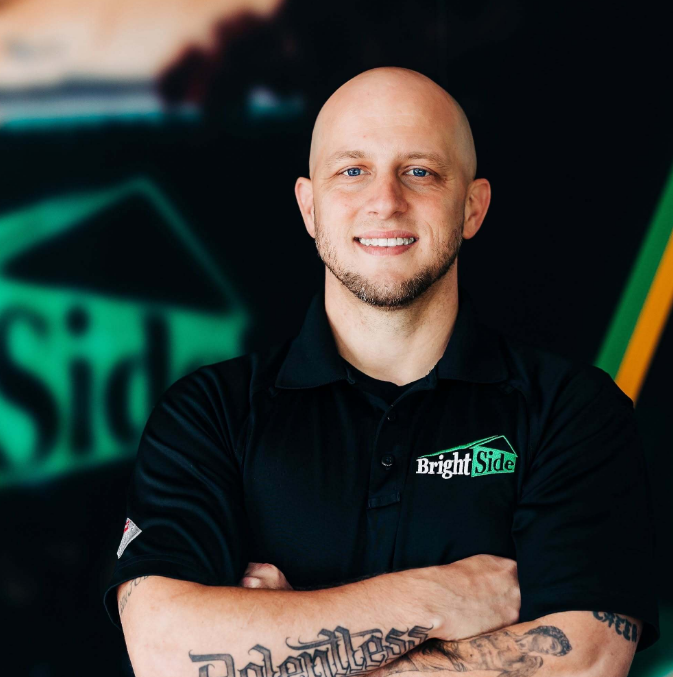
Jones grew up in Magnolia, Delaware, in a single-wide trailer. His mother was diagnosed with cervical and ovarian cancer, requiring many surgeries, and ultimately she was prescribed OxyContin. When OxyContin was discontinued, she resorted to heroin use and crack cocaine. Jones’s father was addicted to crack cocaine, which Jones attributes to the drug use in the household.
Jones never realized his family was struggling, but his school did. They had Child Protective Services step in and start an investigation of Jones’s family, eventually leading to him and his siblings being put into foster care. For the first couple of foster homes Jones stayed in, he was with his younger sister, while his half-brother stayed with their grandparents. Jones kept moving from home to home, having been in six different school districts by 6th grade. At a certain point, Jones and his sister were sent to different homes.
Then, the summer after 6th grade, when Bobby Jones was 12, he was sent back home to live with his parents. There was no power, no vehicle, and his parents had no driver’s license or job. They relied on food from churches and an extension cord running from a neighbor’s house, which powered their refrigerator and TV.
At 13, Jones broke into someone’s trailer, stole a bike, and was arrested for the first time for burglary. Jones didn’t end up going to jail, but discussed how at this moment “something really interesting happened…you’re taught all these things that if you get in trouble, you’re gonna mess up your life. If you get arrested, you’re gonna mess up your life. If you go to jail, you’re gonna ruin your life. And so these things started happening for me because I got arrested at 13 for the first time.”
Jones was arrested again at 14, and this time served two years in detention centers. He was sent to Stevenson House in Milford, Delaware, for four to five months. He was then sent to a program in Pennsylvania, where he was treated for addiction because he had been caught with drugs. However, he got into a fight and was kicked out of the program and was sent back to Stevenson House. He then went to the Ferris School for Boys for six months.
At this point, Jones felt that “I just ruined my life. So, oh, okay, well, I don’t have a chance anymore.”
After leaving the detention center at 16, Jones’s parents split up. He lived in a camper behind his uncle’s house with his dad. It was there that Jones met his current wife, Heather. Jones has said about their relationship, “It has been a rocky road…And I was not a good person. I wasn’t a good boyfriend. I wasn’t, at times in our marriage, I wasn’t a good husband…But I’m happy to say that, like, we made it through stuff that like nobody makes it through.”
Then, at 17, Jones was charged as an adult for robbery. When offered a plea deal to go back to the Ferris School for Boys, Jones declined because he didn’t want to return to Ferris. While waiting to go to court at Stevenson House, his girlfriend, Heather, bailed him out. While out on bail, Heather got pregnant with their now-eldest daughter.
Jones was then sentenced to 8 months in Smyrna, Delaware. While in prison, his girlfriend gave birth to their daughter. He met his daughter for the first time on a visit to the prison. He was only able to hold her for 30 seconds at the beginning of the visit and long enough to pay to take a photo of the two of them.
After being in and out of jail three more times, Jones went to prison for possession with intent to deliver cocaine. By 21, he had been arrested 6 times, accumulated multiple felonies, and had been in and out of prison. He was then charged with assault and charged a fourth time for burglary. Jones said, “When you have like this vast amount of different charges, they definitely look at you as a menace to society.”
What Jones didn’t realize at the time was that he had been accruing time because he was violating his probation with new charges. The backup time from previous sentences had finally caught up to him.
He was offered a plea deal of 33 years for his burglary charge because he was viewed as a habitual offender. When going into trial, Jones says he was “Praying and wishing for like 10 years, like five years, 15 years, something I could manage, something I can come home from, recover, be a part of my daughter's life.”
Once at trial, in 2007, Jones’ public defender decided to bring in a lineup of men from the holding cell. He wanted to see if the witness who saw Jones commit burglary could identify Jones among the other people. Despite standing among people who looked dissimilar to Jones, the witness claimed that the man he saw wasn’t in the courtroom, allowing Jones to go home the same night and having his case dismissed.
Jones says of that moment, “That’s the moment that everything changed for me…In that moment, the real prison that I was being released from was not made of concrete and steel. It was made up of every limiting belief, every set of victim mentality that I had in my mind.”
Jones was determined to get back on his feet. However, he still faced many barriers due to being formerly incarcerated. According to Jones, “Every single time I get to this box that says felon or not, I have to check it. And if I do check it, I never get to the next step.”
He realized the typical hiring process wouldn’t work for him. Instead, he bought his cousin’s ill-fitting suit and showed up to Walmart, telling them that he had an interview scheduled for 11 o’clock. After sitting around waiting, a manager came out to talk to Jones. Jones realized, “Here's my chance ‘cause now I got a platform. When I'm filling out this application, I don't have a platform. I can't speak to that person this way on the application, so I sat down with him, got the job all right, it was a retail store, and so I got hired.”
He was hired at Walmart in a seasonal position. After two weeks, he was promoted to manager. And within four years, he ran the entire left side of the store.
After working at Walmart, Jones was able to see better things for his future. He realized, “I'm still working for somebody else now, right? So what if I started my own business? What if I was my own boss? What if I was employing people and giving people chances, right? So that's what I did.”
After being released from jail in 2007, five years later, Jones was in business. He started Bright Side Roofing, which offers roofing repair, replacement, rejuvenation, and solar power. By their second year, Bright Side Roofing made two million dollars. In 2019, Delaware Business Times recognized Bright Side as one of the fastest-growing businesses in Delaware. By 2024, they were named “Small Business of the Year” by the Central Delaware Chamber of Commerce. And in 2025, Bobby Jones was named one of Delaware’s Achievers and Innovators Under 40.
Jones also gives back to Delaware. Bright Side Roofing donates four roofs a year to Central Delaware Habitat for Humanity. Additionally, Bright Side Roofing sets aside $250 from each roof sale to support roof repair for local veterans in need.
Bobby Jones is also a public speaker who works with Leadership Central Delaware and the Ferris School for Boys to inspire future entrepreneurs. Jones also serves as a regional partner for Master Networks, a service for entrepreneurs and business leaders, where he offers leadership training and networking to entrepreneurs looking to scale their businesses and empowers others to grow their businesses within their communities.
According to Jones, “A miracle is not going to come. It's just not going to happen, right? Like we're not gonna sit there praying for a miracle, praying for chance. Like that's not something to bet on. Bet on yourself. You’re the one that can make it happen and not happen.”
Written by Lizzie Zolandz, Journalism 2026